Showing posts with label Paul McCrane. Show all posts

Sunday, 20 May 2012

Robocops (1987-1993)

Once again our excellent Picture House cinema The Belmont was showing a classic film, this time as part of the Culture Shock series. So it was that I was very much looking forward to seeing Robocop for the first time ever on the big screen (I was only 10 when it first came out). I had been thinking about reviewing all three Robocops for a while now, and this gave me the ideal opportunity to start. So here are three brief reviews of a classic 80s film and two not-so-classics!


Robocop (1987)


Director: Paul Verhoeven.
Writers: Edward Neumeier, Michael Miner
Starring: Peter Weller, Nancy Allen, Miguel Ferrer, Kurtwood Smith, Paul McCrane

Peter Weller is Murphy, a cop in the Detroit police force; left for dead when a notorious gang of criminals shoot the hell out of him, he is saved and re-incarnated as a cyborg who is out for revenge. Director Paul Verhoeven did a great job in creating an iconic hero, and a brutal action movie. By making it a bit tongue-in-cheek and ever so slightly hammy he managed to make Robocop a cult classic.

Helping out is a solid cast. Peter Weller and Nancy Allen are fairly convincing partners; Miguel Ferrer is great as the epitome of 80s yuppy corporate culture, and Kurtwood Smith (That 70s Show), & Paul McCrane (ER) in particular are great criminals. Everything adds up to create a fun, brutal and cool movie that could have been instantly forgettable, but instead is actually pretty great.

Things you might like: Seriously violent; lots of blood; great 80s sleaze performances; badass Robocop; eminently quotable; great score from Basil Poledouris; Paul McCrane being melted by toxic waste!

Things you may not like: Stop motion animation on ED209; ED209 growling and squealing like a pig.

Rating: 4 jars of baby food out of 5


Robocop 2 (1990)


Director: Irvin Kershner
Writers: Edward Neumeier, Michael Miner, Frank Miller
Starring: Peter Weller, Nancy Allen, Tom Noonan, Gabriel Damon

Robocop is on the trail of a notorious gang of drug dealers who are peddling the designer drug Nuke. When the leader of this drug ring, Cain, is killed; through various nefarious deals of questionable morals, OCP re-incarnate him as Robocop 2 - a cyborg that Murphy must eventually have a showdown with.

Astounded as I was when I noticed that Empire Strikes Back director Irvin Kershner was at the helm of this project, he couldn't save it from being a very mediocre film. The over-riding story of OCP ruining Detroit so that they can start construction on Delta City is good enough, (it's the same writers throughout the trilogy + Frank Miller for 2 and 3) but the execution just isn't good enough. I think Kershner et al tried to distance themselves from the "I'd buy that for a dollar" feel of the first film, but playing it straight just didn't work; especially when Robo was re-programmed. Shudder.

Tom Noonan was fairly forgettable as Cain, though I was a little impressed with Gabriel Damon's performance as Hob, he's not bad for a kid, though I've seen a lot better. The other problem is that the special effects used are not up to much; Robocop vs a very obviously stop-motion animated Robocop 2 just doesn't cut it. Imagine Tony Stark vs The Dude at the end of Iron Man, but crap. In the first film the main bad guy was a man, not a robot, which worked great. Trying to up the ante by having a robot vs robot climax just didn't work for me.

Things you might like: Robocop saying "Isn't this a school night?" to a bunch of kids in an arcade; OCP being desperate to control Detroit; at least Peter Weller, Nancy Allen and Robert DoQui as the Sergeant are still there!

Things you might not like: Re-programmed Robocop; paper thin bad guy characters, un-convincing climactic battle; fairly lazy un-imaginative direction.

Rating: 2 out of 5 canisters of Nuke.



Robocop 3 (1993)


Director: Fred Dekker
Writers: Edward Neumeier, Michael Miner, Frank Miller
Starring: Robert John Burke, Nancy Allen, Rip Torn

OCP have finally gone too far and are employing a brutal Rehab squad to clear people out of their houses to make way for construction of Delta City. Robocop sympathises with the underground resistance to these Nazi-style clearances, and follows them to their hideout. OCP are being taken over by Kanemitsu, a Japanese company who have a vested interest in Delta city; but when the CEO of Kanemitsu learns of Robocop's defection and the resistance to rehabilitation he sends over his highly trained assassin. Yet another mess for Robocop to sort out.

For the third outing, Monster Squad director Fred Dekker was chosen to run the show. Robocop 3 was his fourth and final film as a director. Nuff said. Again, the story of OCP (now run by a new CEO played by Rip Torn) trying to control the whole city is a fair one, but the plot is lame, the script bad and the acting for the most part woeful. Rip Torn is about the only good performance, he has quite a commanding presence. Even Peter Weller couldn't be tempted back for the 3rd instalment.

There are far too many stupid plot holes and daft bits to list, and the less said about the rubber-faced Japanese assassin the better. In some vain attempt to boost audience numbers, the rating was dropped from the 18 certificate of the first two films to a 15. Consequently, there is none of the brutal action of the first films; indeed the action in Robocop 3 is probably more TV A-team than anything else. A real whimper of a film to end a trilogy that started with such a bang, indeed several bangs of shotguns.

Things you might like: erm... Rip Torn?

Things you might not like: Robocop's silly arm accessories, awful script, generally bad acting, little or no real action, Jet-pack sequence!

Rating: I wouldn't buy that for a dollar.


Final thoughts

It's a shame that since the first film is so enjoyable, the follow up films taint Verhoeven's 80s classic. Taking the three films together, the one thing I do like is the overall theme of corporate evil. OCP are clearly in big business to make as much money as possible, and as they become bigger their scruples become fewer. The ends justify the means, even if the means demand exploiting people and destroying lives. This theme is as relevant to day as it was 20-25 years ago; it takes an effort to not buy anything today that has either a Unilever or Nestlé label on it. Huge corporations are here, and though they might not be building destructive robots, their ethics are often very questionable.

Sunday, 5 December 2010

Science on Film


On my twitter profile I claim that I am a scientist (true), evil genius (probably not true), and part-time movie blogger (true). So it is in my capacity as a scientist (Microbiologist to be exact, though I have dabbled in Biochemistry as well), that I wanted to be critical of, and in praise of how science is shown in films. Of course due to my biological science background, a lot of what I’ll say reflects this; I’m sure a chemist or a physicist would come up with a completely different set of examples, maybe even a different conclusion.

Generally I don’t think science is portrayed well/accurately in films. Though to be honest this can probably be said of various media, and of various topics. I think for the sake of an exciting film/TV programme/newspaper article, technical accuracy isn’t always 100%, whether it is scientific, historical, or biographical. Perhaps the difference is that science is logical, experimental, and (should be) based on unbiased facts; ie things are done for a reason. Consequently, when it is obviously done wrong, at best it’s like a slap in the face, at worst it’s just laughable. This of course is a problem (should be a problem) for the filmmaker, because as soon as a punter laughs at something that is supposed to be serious (now I’m not thinking of Yoda at the end of Episode II at all!), then in their eyes the film loses all credibility.

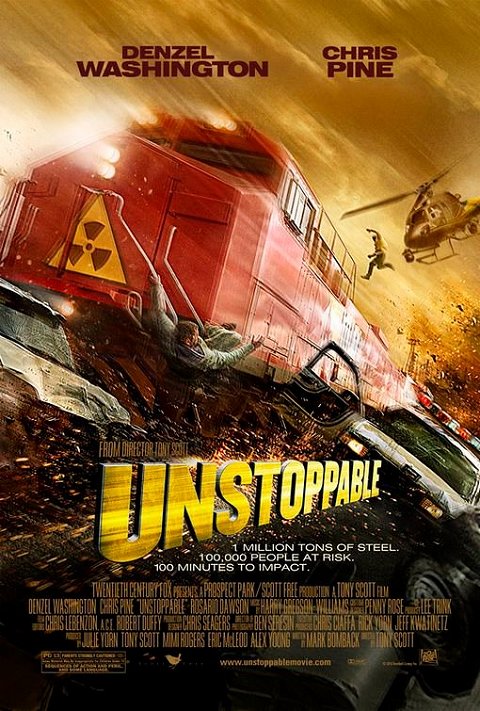
So a slap in the face for me is my pet love/hate; Radioactivity. This is the warning sign for radioactivity:

It is so because the chemical elements that are radioactive are unstable. Due to this instability they break down and release radioactive particles. Therefore the warning symbol shows two “objects” balancing on one, an unstable design. Therefore, to show the symbol upside-down is not only meaningless, but implies the complete opposite of what is trying to be conveyed; “This substance is stable, no danger here”! Actually there are specific rules as the dimensions of the symbol: http://en.wikipedia.org/wiki/Hazard_symbol#Radioactive_sign

                                                         Unstoppable: All sorts of wrong

                                                              Back to the Future: Correct

While we’re on the subject of things being just plain wrong, here’s another corker. This time from The Matrix. And I quote:

Agent Smith: I'd like to share a revelation that I've had during my time here. It came to me when I tried to classify your species and I realized that you're not actually mammals. Every mammal on this planet instinctively develops a natural equilibrium with the surrounding environment but you humans do not.

WRONG! If only the Wachowski brothers had taken 10 seconds to check Wikipedia, they would have found that mammals are so called because the female of each species possesses mammary glands! And last time I checked, humans fall into that category!

Smith then goes on to say that we are actually viruses. Well, we’re not, but viruses are very interesting. Not least in the context of this article as they possibly (though I have no evidence for this - bad scientist!) inspired Alien, at the very least. We all know the life cycle of an Alien: Queen lays eggs, eggs hatch, facehugger jumps on unsuspecting passer by and impregnates, chest-burster bursts out killing host, and Xenomorph can then grow up and lead a healthy and fulfilling life!

In many ways a bacteriophage virus is very similar. A bacteriophage is a virus than infects bacterial cells. When the virus finds a bacterium, it will attach itself, and then “impregnate” the cell with it’s own DNA. The virus then exploits the host cell processes to make many new copies of the viral DNA; new viral particles are then assembled within the host cell, until it eventually bursts releasing all of the new viruses.

As can be seen from this video, the bacteriophage even look fairly horrific.


The video may be a bit over-dramatic, but you get the idea! So we should tip our hat to H.R. Giger, and Ridley Scott for making a Sci-fi film about an alien with accuracy; because few things are scarier than nature! And as if to confirm this, watch this video of the Cordyceps fungi that infect insects and then grow out of the host body!

So some of those horrific Sci-Fi creatures may have some basis in science and nature, though it may not be intentional some times. And while we’re at it, if you thought that The Thing was a bit too far fetched, then you really don’t have to look any further than Dictyostelium (Slime Moulds):


Then from the sublime to the ridiculous. That special breed of film that contains that particular branch of science: Spacker Science! Whether it be trains of molten phenol in Unstoppable, or toxic waste melting Paul McCrane in 10 seconds in Robocop! But all pale into insignificance when compared to Deep Blue Sea! Ah yes.

“Scientists” discover the cure to Parkinson’s disease; a protein that causes neurons to fire again (which happens instantly in a petri dish!). So, shall we copy the gene for the protein into E. coli, so that it can be propagated and produce loads of protein in the lab (standard practise, even I do this in the lab)? Or shall we breed giant sharks, with giant brains, so that we can pipette the protein directly out of it’s brain?! I’m sure there was a reason for the sharks particularly, but I can’t remember what it was. Of course, giving sharks larger brains makes them super-intelligent! Of course we all know that this is true; larger brains = greater intelligence. That is why the elephant is the most intelligent mammal!?

I could sit here all day and pick holes in this film, but then that’s not it’s point is it. As I said earlier, to make something like a film more entertaining, there has to be a certain amount of willing suspension of disbelief, especially when it comes to science. Let’s then be honest, who wouldn’t find Samuel L. Jackson being eaten by a giant shark, or Saffron Burrows stripping down to her knickers and bra so she can electrocute a shark, or L. L. Cool J telling us how to make an omelette entertaining?

I think science generally comes off quite badly in films; if it is not accurately done, then scientists themselves are usually portrayed as socially inept nerds who live only for their research and barely see daylight. There are a few good examples of films, but I don’t really have the time to go into Contact (written by Carl Sagan), or 2001: A Space Odyssey, or Sunshine (Professor Brian Cox was scientific advisor), and I’m sure more films that escape me right now.

As I said at the beginning, there are reasons for scientific theories and ideas. Research, experiments, and drawing the most likely conclusions based on evidence (almost Occam’s Razor) is how we progress our knowledge. Perhaps the conclusions may not be completely correct at the moment, but this is the point of research, to question accepted dogma if we have reason to doubt it, or in the light of new evidence. This is why when it is done badly/wrong in films it just looks silly because it just doesn’t make sense.

I should finish by saying this doesn’t necessarily ruin films for me, despite perhaps being “pulled out of the film” by some stupid science, I still think the like of Deep Blue Sea, Robocop, Watchmen, The Thing, AVP, The Matrix are all still great/very entertaining films (I’ll let you decide which of those you think I think are great or just very entertaining!). It would just be nice if Directors/writers/producers/set designers could just do a little bit of research themselves to make sure their film was slightly less silly!