Showing posts with label Westerns. Show all posts

Sunday, 31 March 2013

True Grit (1969)


Far more traditional and technicolour than the Coen brothers' excellent 2010 remake, this version is never the less a great western.  Not a hotel chain.  There is some glorious cinematography of amazing landscapes, a rousing if repetitive score and a great performance from John Wayne.  Even Matty Ross is really good despite reminding me of a very young Prof Brian Cox!  I really expected her to be fairly wooden in light of how brilliant Hailee Steinfeld is in the 2010 film, so I was impressed with how effortless Kim Darby's performance is. 

                                              An early still from Wonders of the Universe!

Having not been too enamoured of Wayne's performance in The Searchers, here he gives us a far more understated, and in my view a more convincing one.  Rooster Cogburn is a cantankerous US Marshall who spends half his hours drunk; who'd have thought that all-American John Wayne would have been excellent at this.  Rooster is far more of an anti-hero than John's character in The Searchers (and I imagine a lot of his other roles), which is probably why I prefer it.  Rooster is far more in the mold of The Man with No Name from Sergio Leone's spaghetti westerns than John's usual American hero image.  Glen Campbell is good as Le Boeuf, and the banter between him, Rooster and Matty is sharp and witty.  The film also throws up a few cast surprises in a very young Dennis Hopper and Robert Duvall, both of who do very well in their minor roles.

Like I say, this isn't quite in the same class as the Coen brothers film, but is still a very enjoyable movie. At the heart of the film is the relationship between the three main characters.  John, Glen and Kim are great together, and it is their quick, witty interaction that drives the film, making it a cut above similar westerns.

Wednesday, 4 July 2012

The Good, the Bad and the Ugly (1966)


Now, I know there are all sorts of Westerns, but if someone starts talking about this genre, The Good, The Bad and The Ugly is what I automatically think of.  Few other westerns have the same dynamism of a Sergio Leone western. They are full of action, have amazing characters and are beautifully shot.  Having said that, I'm really looking forward to Django Unchained in 2013.

Having wowed the world with his dynamic, violent style in Fistful of Dollars and For a Few Dollars More, TGTBATU is the icing on the Sergio Leone cake.  It's a film that is in no hurry.  The first half an hour are spent slowly introducing the characters: Tuco (The Ugly) is evidently often a wanted man, but is perfectly capable of looking after himself.  Angel Eyes (The Bad) is a real mercenary and will stop at nothing to get his hands on as much cash as possible. Finally there's Blondie (The Good), still quite the mercenary, but with more scruples than Angel Eyes.  It's typical of Leone that even the "hero" (The Good) is a morally ambiguous character.

After these introductions we get into the story proper, these nefarious characters are trying to track down a cash box buried in a graveyard.  Of course it's not as simple as that, they get there via various altercations and encounters with the Unionist and Confederate armies, as well as each other.  However, when the graveyard is reached, the climax to the movie is 25 of the best minutes ever committed to film.  Leone's style is most evident here as the camera slowly gets closer to the protagonists using static shots of faces, eyes, hands and guns.  I have talked more about this in my Sunday Scene; quite simply, it's superb.

Behind all this wonderful direction and editing is an amazing score from Ennio Morricone.  Perhaps it is the theme music from the film that is most famous (perhaps even the most famous music from a Western), but The Ecstasy of Gold and "The Trio" showdown music are truly magnificent.


The three stars are quite brilliant.  Lee Van Cleef is the perfect embodiment of The Bad; the piercing blue eyes, the mousey smile, all played with such gleeful recklessness.  I know that Clint's character is meant to be the main hero, and Blondie is the epitome of cool, but it is Eli Wallach's portrayal of Tuco that is the highlight of the film.  He has the best lines: "If you're gonna shoot, shoot! Don't talk!", and the scene in which he "buys" a gun in a shop is pure genius.  Tuco is very much an adolescent character trying to survive in a man's world, and as such always seems to make it through by the seat of his pants.  Eli Wallach always manages to make his beady eyes full of wonder at the possibilities available to him, but at the same time terrified by what might happen to him.  This is no better demonstrated than in the truel at the end of the film: his beady eyes searching, his mouth twitching as he tries to second guess his opponents, and his gun on a piece of string! He could win so much, but he could lose everything.  Superb.


I’ve only really scratched the surface of what makes this a fabulous film, and I know I haven't done credit to how excellent TGTBATU really is.  Cast, action, music, style, composition of shots, script (have I forgotten anything?) all completely excellent, and one of my all time favourite films.

Tuesday, 3 July 2012

The Assassination of Jesse James by the Coward Robert Ford (2007)


The Assassination of Jesse James by the Coward Robert Ford (AJJ) does exactly as it says on the tin, but does so in a truly spellbinding way. The film charts the final days of Jesse James’ life (Brad Pitt) following his last train robbery, his descent into paranoia & depression and finally his murder by Bob Ford (Casey Affleck) who has ingratiated himself into Jesse’s gang before his ultimate betrayal. Brad Pitt is as excellent as he usually is, but it is Casey Affleck’s performance that stands out. He really nails the nervous determination of Robert Ford; in the scene just before he kills Jesse he looks truly terrified as if he’s about to throw up. Surrounding these two main players are an impressive support cast including Sam Rockwell and Jeremy Renner.

Robert’s character is quite an interesting one; rather than being a coward, as the youngest member of the James gang, he is butt of all the jokes and never taken seriously. It is this insecurity and desire to prove himself that drives him to murder Jesse. This is despite the fact that he worships Jesse. For years Robert has collected comics of the adventures of Jesse, and at one point Jesse says to him that he doesn’t know if he wants to be just like him or to be him. There is never any mention of the fact that he could be gay, but the way he constantly glances at Jesse certainly raises that possibility. Actually Robert is no less cowardly than Jesse himself, as during his descent into paranoia Jesse takes an ex gang member “for a ride” and shoots him in the back!

The movie is beautiful, really stunning. Andrew Dominik’s direction is sweeping, yet simple; and the cinematography by Roger Deakins is as amazing as usual and gives the film an epic feel. The pace is slow, but perfect for the film, and a shorter run-time would make everything feel very rushed. Complementing the bleak, melancholic feel the film has is the beautifully haunting, lugubrious soundtrack composed by Nick Cave and Warren Ellis, who bring an incredible atmosphere to the film. These are the guys who composed the soundtrack to The Road, so you can imagine the ambience, but the AJJ soundtrack is easier to listen to. For those with Spotify: Jesse James

A really interesting film, with amazing scenery, great cast, beautiful music and tremendous atmosphere.


Monday, 2 July 2012

Once Upon a Time in the West (1968)


“People scare easier then they’re dyin”

The subtitle for Once Upon a Time in the West could easily be How the Wild West Ended. Everything about the film suggests the end of an era, or at least the end of something. Harmonica’s tune is like a death rattle, we feel ultimately that it will build to a dramatic crescendo, but it takes time to get there; it is reminiscent of a tortuous death. Indeed Jason Robards’ character, Cheyenne, goes even further and suffers a long drawn out death; having been shot off-screen it takes him a full 20 min at the end of the film to die. If the pace of the film and the music wasn’t enough to suggest last gasps, the central theme is stated by Harmonica when he explains that Man is an ancient race, and that businessmen will come along and kill it off. It is the rise of the businessmen and the expansion of the railroad that is ending the time of the outlaw.

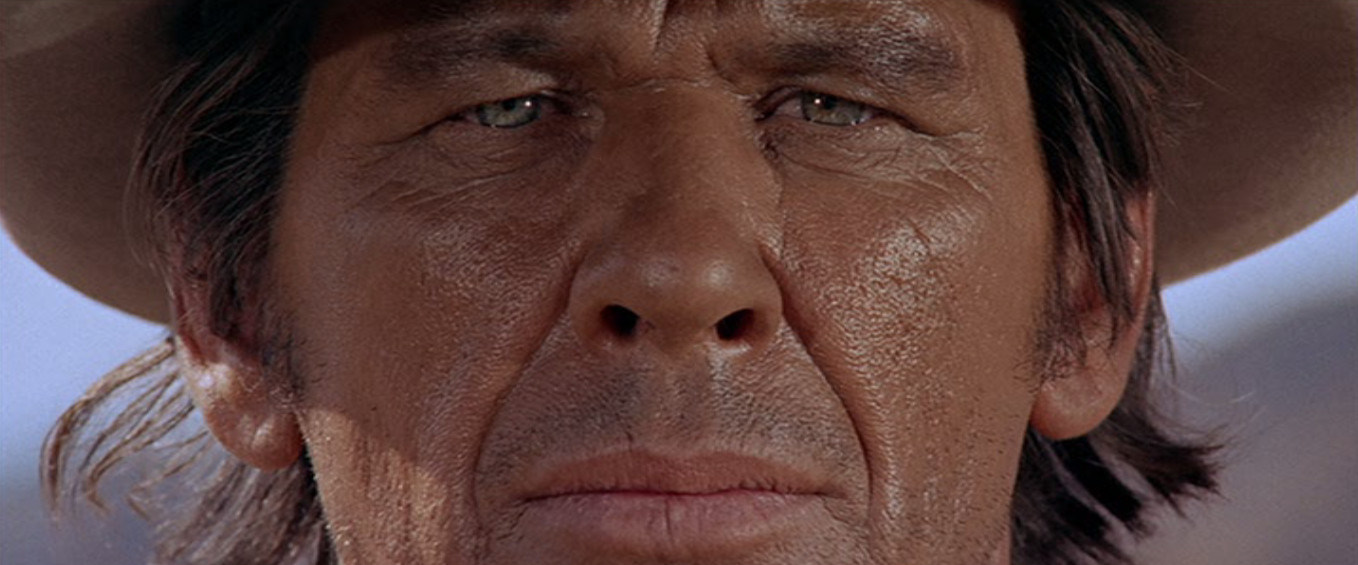
There is plenty of fabulous scenery and many sweeping crane shots, revealing huge sets and hordes of extras in the rail gangs. Of course being a Sergio Leone film there are lots of close ups of the characters, concentrating in particular on their eyes. I’ve never seen either Charles Bronson or Henry Fonda in anything else, but here they both look like real mean bastards! Leone also has an eye for the stylish and dramatic, and this is no more evident than the very start of the film. There is 10 minutes of three guys waiting at a railroad station, barely any dialogue, a squeaking windmill and a buzzing fly; but it is phenomenal. A very brave way to start a film, it sets the pace for the rest of the story perfectly. Of course on top of Leone’s inimitable style, Ennio Morricone’s score is as fabulous as ever.


All of the main characters are flawed. Like I say, Harmonica (Bronson) and Frank (Fonda) are both ruthless men; Harmonica is out for revenge, and Frank is just evil. Cheyenne (Robards) is a likeable rogue, but by no means a good guy; even Jill McBain (the gorgeous Claudia Cardinale), the traditionally “good” character, is an ex-whore. Whereas in other Westerns there is a character that the viewer routes for (usually Clint Eastwood in Leone films), in OUATITW there is no-one really. We hope that Harmonica gets his man, though we don’t know what injustice he suffered in the past; but that’s different to empathising with a character. In terms of performances I think Cardinale and Fonda are the two that stand out. Cardinale manages to switch emotions from excited and hopeful, to horrified and scared very well, yet she always seems to be in control. Fonda is perfect as Frank; playing against his usual type, he seems to really enjoy playing a real villain.


A superb, beautiful film, with some typical, but none-the-less excellent, stylish direction from Sergio Leone, and very atmospheric music from Morricone. I hesitate to mention the tempo of the film, which can sometimes feel like it’s dragging, because the slow pace is an intended feature of the film. This doesn’t detract from the epic scale of the film, and it hasn’t stopped me from seeing it many times.


Saturday, 28 January 2012

The Outlaw Josey Wales (1976)


Set against the backdrop of the American Civil War, The Outlaw Josey Wales is a story of revenge and retribution. When a rogue group of Unionist soldiers known as the Redlegs attack Josey’s farm, killing his wife and son, he joins a group of men aiming to bring their own flavour of justice to the Redlegs. With the end of the war the renegades turn themselves in, all except Josey, who becomes outlaw number one.

Josey is a very interesting character; initially emotionally broken by the murder of his wife and son, he becomes a real hard man, shooting and killing his way to inner peace. As the film progresses we learn that he never lost the desire to lead a peaceful life with a family. As he travels, evading both the Unionist men hunting him and Bounty Hunters, he meets/rescues other lost souls until he has essentially surrounded himself with a surrogate family. It is also quite striking how Josey portrays the native Americans in the film. In a lot of classic Westerns the “Injuns” are the bad guys; the enemy here is definitely the soldiers who murdered his family, whereas the Cherokee and Navajo are just people (funnily enough) who believe in Josey. Even when Josey meets Ten Bears, the chief of a ferocious-looking tribe, he speaks to him as an equal and negotiates a peaceful solution.

Of course what we want to see in a Clint Eastwood Western is Clint being quick on the draw, delivering a great script, and generally being cool; and Josey Wales doesn’t disappoint. There are plenty of duels/shootouts/sticky situations; all of which are dealt with in typical cool Clint style. The film also looks amazing, lots of lovely cinematography of the Utah landscape giving a really epic feel. The cast is great, low-key (if a cast can be low-key?), and they all work really well together. However I feel that I must mention Chief Dan George who plays Lone Watie, the first person that starts to tag along with Josey. He is the main supporting actor I guess, and he is great; laid back, sarcastic, and has quite a sense of humour, and (get this) he was born in 1899! That’s crazy!

This is the fourth film that Eastwood both directed and starred in. When I recently watched The Town, the DVD extras make a big song and dance about how great Ben Affleck is because he both starred and directed. I enjoyed The Town, but Clint has been starring and directing since before Affleck was born! Though credit to Affleck, he was 38 when the made The Town, and Clint was 41 when he made his first film, Play Misty for Me.

In a time when interest in Westerns was waning, Clint really invigorated the genre when he made Josey Wales; to such an extent that it received a nomination for an Academy Award. OK, so it was for best original score, but it’s impressive that the movie got that much attention; and not that I generally put much stock by these things but the film still has a 94% fresh rating on Rotten Tomatoes! I think that it is a great film; simple yet effective revenge story, Clint is wonderful as the outlaw who has far more of a moral compass than the Unionists, great dry sense of humour in the script, excellent supporting cast and wonderful scenery.

Sunday, 13 November 2011

The Searchers (1956)


That’ll be the day.

Comanche Indians attack Aaron Edwards’ homestead, killing the whole family, except young Debbie, who they kidnap. Aaron’s brother Ethan (John Wayne) and Aaron’s adopted son Martin Pawley (Jeffrey Hunter) set out to find her on what turns out to be a rather epic journey. Often referred to as John Ford’s finest and most emotionally complex film (so I’ve read), there is no doubting its scope, or John Wayne’s performance, but I felt a little underwhelmed by it all.

Filimed in Monument Valley (John Ford’s favourite shooting ground), the film is stunning to behold, and beautifully composed. However, by limiting the shoot to pretty much one location (the occasional snowy scene was filmed in Colorado), the film felt a little claustrophobic to me, rather than the expansive epic it purports to be. As a slight aside, the film is meant to be set in Texas - despite even the trailer announcing that it was filmed in Arizona! Now I’ll accept that for various reasons some movies need to be shot in locations vastly distant to the intended setting; but when your scenery is as iconic as Monument Valley you can’t pretend it’s anywhere but Arizona. Of course, my claustrophobia here could be solely due to the fact that I have driven around Monument Valley in a couple of hours, and spent the film spotting familiar rock formations.


Of course this “cramped” location means that the editing has to be done well, which it is, and the photography is top notch; there are lots of nice shots of John Wayne posing in front of buttes and mesas. John Wayne is easily the best part of the story; his Ethan Edwards is cranky, bloody-minded, prejudiced, yet 100% committed to the cause; and Wayne mostly manages to bring all these traits together successfully. Unfortunately I feel that this focus on Ethan’s character means that all of the others were forgotten about. Jeffrey Hunter is mostly alright as Ethan’s primary companion, but he is given to the occasional drama-queen moment; as can be said for most of the female cast.


An enjoyable western, but I feel perhaps that it hasn’t aged well; a lot of the acting is wooden and shouty, and features an atrocious Irish (I think) accent. Also, the passage of time was not slickly illustrated - it did not ring true that they spent five years looking for Debbie (judging by the scenery they had been going in circles for most of that time). The searchers also seemed to have very short memories; being chased by Comanche one scene, and then not knowing where to find them the next. John Ford’s direction for the most part is great, but it felt a little sloppy in places. I’ve obviously been spoiled with more modern westerns; but there was very little plausible emotion beyond Wayne. I realise that this is supposed to be one of the finest westerns made, and I still want to see more Wayne/Ford collaborations, but The Searchers was not as fantastic as I expected.

Sunday, 2 October 2011

Tombstone (1993)


Unfortunately I'm writing this so long after I saw the film (about 5 months) that I've forgotten most of it! I do remember that Wyatt Earp (Kurt Russell) moves out to Tombstone, AZ, having given up being a bad-ass Sheriff; but he can't get away from it all as easy as he hoped. No matter how he tries, he can't keep from antagonising bad guys (of which you would imagine there were quite a few in a place called Tombstone), he makes enemies and there is a chain of events that leads up to a shootout at the OK corral.

The only other thing I can really remember is that Val Kilmer was surprisingly good as the sick and ailing Doc Holliday. Maybe if I watch this again I'll post a better review in the comments below. I do remember it was quite enjoyable though!

Saturday, 1 October 2011

Butch Cassidy and the Sundance Kid (1969)


“Oh, good. For a moment there I thought we were in trouble”

This 1969 film directed by George Roy Hill recounts some the escapades and close calls of two of the most enigmatic outlaws in American history. I only saw this film for the first time recently and fell in love with it; and although I generally think westerns are brilliant as a genre, this is something very different from most of them. So here are 5 reasons why I love Butch Cassidy & the Sundance Kid.

1) Chemistry

Of course I’m referring to the onscreen chemistry between Paul Newman (Butch) and Robert Redford (Sundance), rather than an H2O2 kind of way. Both actors are fantastic, and the banter between them feels so natural and organic (chemistry again!). Newman is lively, cocky, quick-witted, and looks like he’s really enjoying himself. Robert Redford is a lot more brooding, and has many a smouldering look (if blue eyes can be smouldering).

I think that there are two scenes early on that really demonstrate the characteristics of these criminals, and their relationship. The first is a card game that Sundance is playing with two other guys in a gloomy bar. Throughout the scene the camera is fixed on Sundance as we see how calm he is under pressure, with total belief in himself. We also find out that his reputation precedes him, as the other gambling fella changes his attitude when he finds out his opponent is the Sundance Kid. Robert Redford is very good, and his eye-acting is equally good! Initially his eyes are flicking between his cards and his opponents, but soon they are just staring out into the middle distance in incredulity; he really can’t believe this guy is accusing him of cheating and is now challenging him.

The second is a scene where Butch’s dominance of his gang is challenged by Harvey Logan. Butch has a quick scrap with him (obviously he comes out on top), but the way he wins is by quick thinking and (sort of) cunning. This really sums up Butch. Just before the fight, there is a brilliant little exchange between Butch and Sundance. Logan announces that if he beats and kills Butch then Sundance is welcome to stay. Butch whispers to Sundance: “Listen, I don't mean to be a sore loser, but when it's done, if I'm dead, kill him.” Sundance simply says: “Love to.” and waves like this:

Fantastic!
Certainly a lot of the best scenes have an element of humour in them as Paul and Bob play off each other, such as the scene before they leap from a cliff into a river, or just before the iconic last scene when Butch suggests that they should go to Australia.

2) Cinematography

Thanks to Conrad Hall (who won the Academy Award for Best Cinematography for his work here) the whole film is gorgeous; as well as wonderful vistas the characters are beautifully framed, and often shot from behind foliage/buildings. Having watched the “Making of” documentary on the DVD, it seems that Conrad liked to shoot into the sun giving the film an overexposed washed out feel to it; a lot of it has a sepia look to it which matches so well with all the still photographic sections of the film.

As I've already mentioned, near the beginning of the film is a scene where Sundance is playing cards with two other fellas (one is Sam Elliott but you don’t really see him). A lot of the exchange between the players is done in one shot, focussing on Sundance (this time being shot from behind the other players), and the lighting for the whole scene is very subdued, adding to the uncertainty of the outcome. Especially brilliant is the last shot as Butch and Sundance burst out guns firing, whereupon the picture freezes, the colour bleeds out to leave a sepia image that the camera then pulls away from. Brilliant and iconic.


3) Script

Of course, one of the reasons that the banter between Butch and Sundance is so good is the quality of the script. Throughout the film the writing is sharp, witty and lively. Of course it helps that Newman and Redford’s on screen relationship is such that the script really comes alive. However, as Newman says in interviews, the script was so good that it would have worked with almost any actors. Presumably it was this genuine quality that the American Academy of Motion Picture Arts and Sciences saw in writer William Goldman’s script when he won the award for Best Writing.

4) We’ve been there!

Apologies for bringing up our amazing holiday again, but films become so much more fun when you can specifically picture being in that landscape. Some sections of the film were shot in an abandoned town called Grafton in Utah, just round the corner from Zion National Park. Unfortunately we only discovered after we had left the area that Grafton was only 5 miles down the road from where we stayed! But some of it is shot in Zion National Park itself:


5) Woodcock / You’re only supposed to blow the bloody doors off!

Woodcock is a minor recurring character, whose role it is to safeguard the safe of money on the Union Pacific Railroad that Butch’s gang periodically hold up. The fact that having blown him up once, Butch recognises his voice when they next hold up a train is a great touch. Unfortunately for Woodcock, having reinforced the safe, more dynamite is required with alarming results:


One thing that you might not like: The slightly silly scene where Paul Newman rides around on a new bicycle, while Katharine Ross sits on the handlebars and Burt Bacharach sings “Raindrops keep falling on my head”! It’s a fairly ridiculous scene even if the song won the Oscar for Best Song!

So there you go, that’s my love letter to Butch and Sundance. What do you think? Is it that good, or am I seeing it through rose tinted glasses after my holiday?

Thursday, 17 February 2011

True Grit (2010)


True Grit is the story of Mattie Ross, whose father was murdered by the outlaw Tom Chaney. Mattie wants revenge for her father's death, and hires notorious U.S. Marshall Rooster Cogburn (known for taking no quarter, and often shooting before thinking) to hunt down Tom Chaney and have him brought to justice. Justice for Mattie is, of course, death. As well as the rather reluctant, grizzly Cogburn, Mattie encounters LaBoeuf, a Marshall from Texas who also wants to bring in Tom Chaney (though LaBeouf knows him by another pseudonym) for killing a Senator. The three set out, and amidst reservation of a girl riding with them, Tom is finally brought to "Justice".

Though Jeff Bridges (Cogburn) is first billing, this is really Hailee Steinfeld's film. As Mattie, Steinfeld is witty, ballsy, never afraid to argue her case, won't take no for an answer, and she gives a very lively and mature performance without ever coming across as being arrogant. A great performance for a 15 year-old. Jeff Bridges is great, as usual, though doesn't stand out in the same way that Hailee does. Jeff is perfect for the grizzly, recalcitrant, slightly maverick US Marshall. I did worry in Bridges' opening scene in court, that I wasn't going to understand a word he said in the film (much like Tommy Lee Jones in No Country for Old Men), but happily that turned out not to be the case; it just took a wee while to get my ear tuned in! Matt Damon is also good, as he usually is, though his role is somewhat smaller and doesn't get the opportunity to shine so much.

This film sees a return of the Coen Brothers to the style that served them so well in No Country for Old Men: great characters, great cast, great screenplay (isn't it always?) and wonderful scenery. Of course one of the reasons for that wonderful scenery is Roger Deakins, the genius cinematographer behind many other visually stunning films (The Assassination of Jesse James by the Coward Robert Ford, No Country for Old Men, Kundun etc etc).

I've never seen the John Wayne version of True Grit (actually I'm not sure I've ever seen a John Wayne film!), but I thoroughly enjoyed this updated version. A great western, more in the mould of Unforgiven than others, but not quite that good. I think I expected it to be more epic, but that is not a criticism, just my over-expectation. A brilliantly shot, superbly acted, humorous revenge story.